

Caregiver and muscle tension
Neck, shoulders, arms: when the body bears the weight of love
A practical guide with an exercise routine, to be done in the evening or in the morning, to release accumulated tension and begin breathing again.
If you care for someone every day, you're probably familiar with that feeling: a tiredness that's more than just sleepiness. It's a stiff neck in the morning, shoulders like stone, a dull ache between the shoulder blades that spreads to the back of the neck. The caregiver's body speaks. And it often speaks through that area of the body that is the intersection of emotional tension and physical exertion: the cervical region.
Lifting, supporting, helping with transfers, bending over the bed, hours on the phone with doctors and social workers—it all adds up silently. And the result is chronic tension that can lead to headaches, tingling in the arms, difficulty turning the head, and sleep disturbances.
First of all: If you experience sharp pain, persistent tingling in your hands, or weakness in your limbs, always consult your doctor or a physical therapist. This routine is intended for daily well-being, not to replace a professional assessment.
A routine that adapts to you
Lifting, supporting, helping with transfers, bending over the bed, hours on the phone with doctors and social workers: it all builds up silently. And the result is chronic tension that can lead to headaches, tingling in the arms, difficulty turning the head, and sleep disturbances.
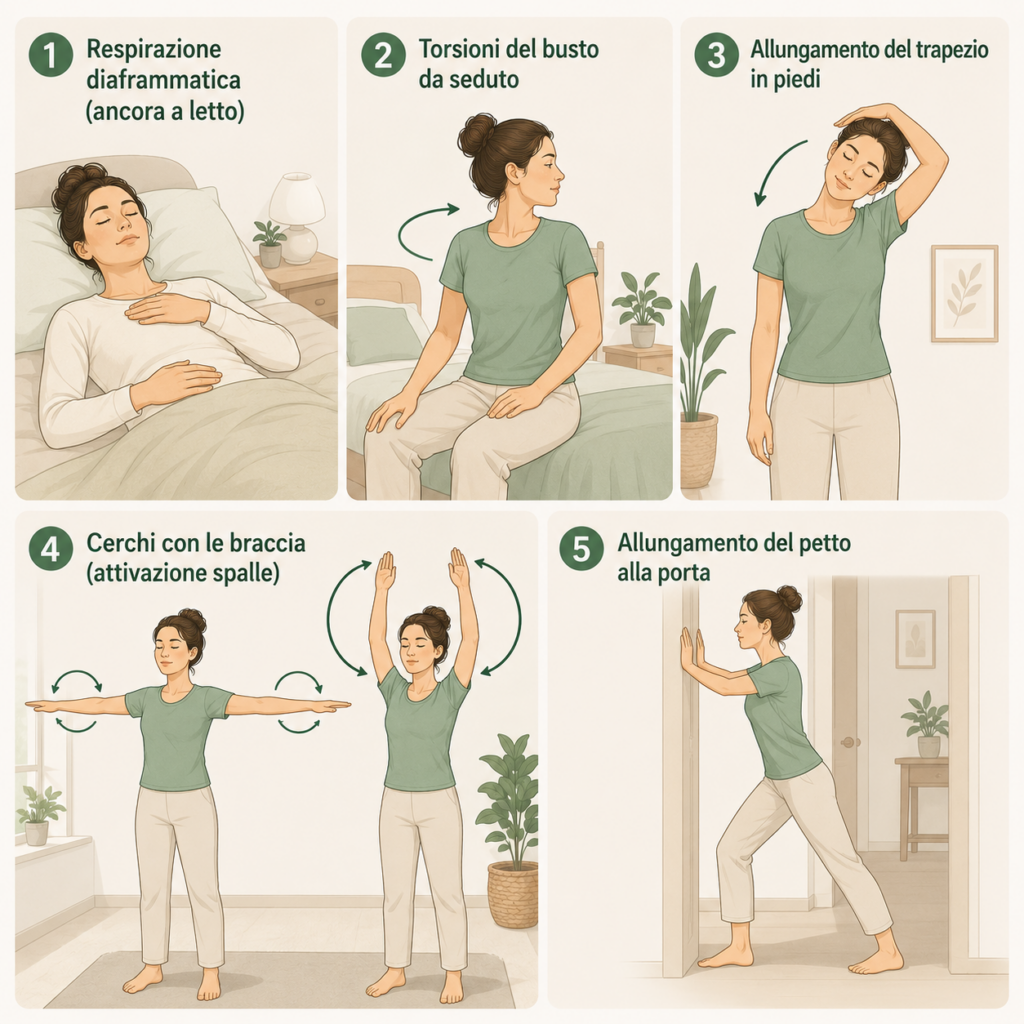
1 Diaphragmatic breathing (still in bed)
Before standing, place one hand on your chest and one on your abdomen. Inhale slowly, expanding your belly, not your chest. Exhale deeply. Repeat 5 times. This activates the parasympathetic nervous system and gently prepares the body for the day.
5 breaths • 2 min
2 Seated Torso Twists
Sitting on the edge of the bed or in a chair, place your hands on your knees. Slowly rotate your torso to the right, allowing your head to follow your gaze. Hold for 3 seconds. Return to center and repeat on the left. Keep your hips still.
6 rotations per side • 3 min
3 Standing Trapezius Stretch
Standing, bend your right arm above your head. With your left hand, grasp your right elbow and gently pull to the left. Simultaneously, bend your neck to the left. You'll feel the stretch along your entire right side. Hold for 20 seconds.
20 sec per side • 2 min
4 Arm Circles (Shoulder Activation)
With your arms extended at your sides, draw slow circles, first small and then larger, first forward and then backward. Feel your shoulders awaken. This mobilizes your joints after a night's rest and reduces morning stiffness.
10 circles per direction • 2 min
5 Doorway Chest Stretch
Place your forearms against a doorframe (at a 90° angle). Step forward until you feel a slight stretch in your chest. Hold for 20 seconds, breathing. This is the best antidote to the closed posture that develops during caregiving tasks.
3 times of 20 seconds • 2 minutes
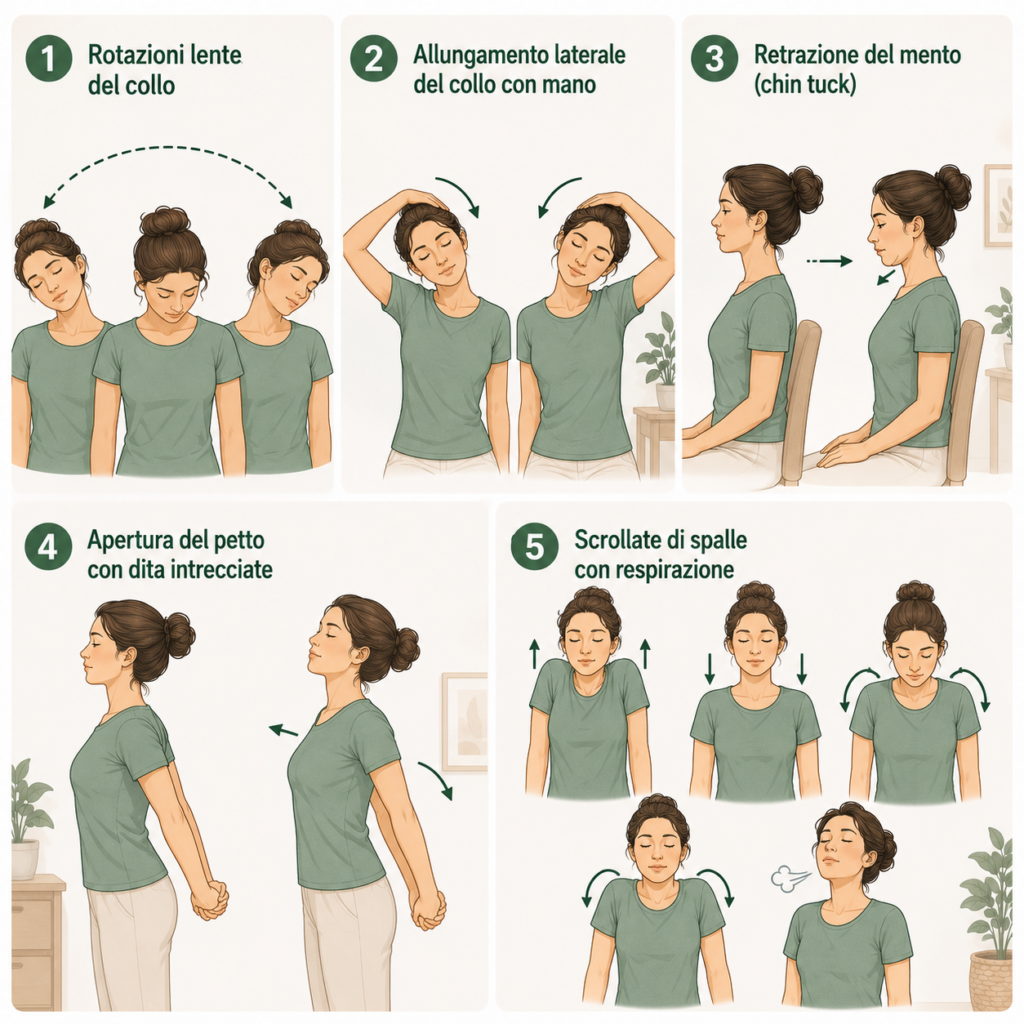
1 Slow neck rotations
Sitting or standing with your back straight, slowly tilt your head to the right, keeping your chin close to your chest. Continue in a semicircle to the left. Never tilt your head completely back. Concentrate on your breathing and the sensation of stretching.
8 slow laps • 2 min
2 Lateral neck stretch with hand
Bring your right ear toward your right shoulder. With your right hand, gently support your head to slightly increase the stretch. Hold for 30 seconds, feeling the stretch on the left side of your neck. Switch sides. Never pull forcefully.
30 sec per side • 2 min
3 Chin tuck
In a seated position, bring your chin back as if you were doing a "second chin." Don't lower your head: the movement is horizontal. Hold for 5 seconds, then release. This exercise repositions the cervical vertebrae and relieves the pressure accumulated from looking down.
10 repetitions • 2 min
4 Chest opening with interlocked fingers
Place your hands behind your back, interlacing your fingers. Open your chest by pushing your shoulders back and down. Keep your chin slightly tucked. Breathe slowly. This counteracts the forward posture typical of caregivers.
3 times of 20 seconds • 2 minutes
5 Shrugs with breathing
Inhale and hold your shoulders toward your ears for three seconds, then exhale and let them fall completely. Repeat, bringing your shoulders forward, then back. Conclude with a big sigh: inhale deeply, exhale slowly, releasing everything.
10 cycles • 3 min
Small gestures, big differences
Routine is important, but so is what you do during the day. Here are four simple habits to incorporate even during the busiest times:
The neck “check-in”
Whenever you're waiting—for the doctor, therapy, or an elevator—use those two minutes to do slow neck rotations. No equipment needed.
The 20-20-20 rule
Every 20 minutes on your phone or computer, look at something 20 feet away for 20 seconds. This reduces neck tension related to staring.
Posture during assistance
When helping someone stand or move, bend your knees, not your back. Even small adjustments over time protect the spine.
Warmth before evening exercises
A hot water bottle on your neck for 10 minutes before your evening routine loosens the muscles and makes the exercises much more effective.
“"Caring for someone is an act of love. But love cannot flow from an exhausted body. Dedicating ten minutes a day to yourself is not selfishness: it is the condition for you to continue being present."”