

It’s 6:40 p.m. Your mom was fine all afternoon. Now she’s pacing the kitchen, asking when someone is coming to take her home. She has lived in this house for forty years. Your voice tightens, hers gets louder, and twenty minutes later it’s over, as suddenly as it started.
A week later, the doctor asks, “So what exactly has been happening?” And all you can say is, “She’s been more agitated lately.”
If you’re an adult child caring for a parent with Alzheimer’s or another dementia, you know this moment. Dementia behavior changes are some of the hardest parts of caregiving, and the details that matter most are the ones that are easiest to forget. This guide shows you what to write down, and why.
A quick note: this article is for general information and is not medical advice. If you notice a sudden or marked change in your parent, contact their doctor promptly. Don’t wait until you’ve finished a log.
Why Dementia Behavior Changes Can Be Hard to Understand
The National Institute on Aging explains that Alzheimer's disease causes brain cells to die, which changes how a person acts. Behavior changes in dementia can include getting upset, worried or angry more easily, pacing, wandering, or misunderstanding what they see or hear. «Dementia: what to do, chow to recognize it»explains that fear, stress, anxiety, environmental factors, and other medical issues can also affect behavior. From the outside, it is often difficult to tell what is causing the change.
The point is that, from the outside, it's almost impossible to determine which of these factors is involved. And rightly so: discovering the cause isn't your job. The same publication indicates that, when faced with crises or difficulties such as agitation, aggression, or insomnia, one should contact a doctor and/or the appropriate Center for Cognitive Disorders and Dementia (CDCD). The Italian National Institute of Health has published a map to locate CDCDs by region and province, with locations and opening hours.
That'sokay because it isn't your job to figure out the cause. The NIA's guidance is simple: if you don't know what's causing a problem, call the doctor. The Alzheimer's Association also lists situations where you should see the doctor right away, including sudden new confusion, a major change in memory or mood, a fall or faint, a fever, or sudden incontinence.
Clinical vs. organizational. Deciding what's behind a change is a medical question. What you can do is organizational: notice what happened, write it down, and bring clear information to the person who can interpret it.
What to Observe Before, During and After an Episode
The Alzheimer's Association suggests being as specific as you can: when does it happen, how often, and does something seem to trigger it? A simple way to organize that is to think in three parts.
Before the’episodio
- What was going on in the hour before? (Visitors, a change in routine, a meal skipped, a restless afternoon?)
- What was the environment like? (Noise, lighting, crowding, temperature.)
During the episode’episodio
- Date and time.
- How long it lasted.
- What did you actually see or hear?. Describe, don't label. «He walked for about twenty minutes asking to go home» he tells the doctor much more than « he was throwing tantrums ».
After the’episodio
- How did it end? Did it go away on its own, did it get worse, or did it end with rest?
- What you actually saw or heard. Describe, don't label. "Paced for about 20 minutes and repeatedly asked to go home" tells the doctor more than "was being difficult."
You're not making any diagnosis. You're gathering a clear picture, which makes a few minutes' visit more useful.
Small changes in the’environment to be controlled
Sometimes context makes all the difference. These aren't cures, they're just practical things to check and note:
- Noise: Is the TV on while other people are talking nearby?
- Lighting: Is the house dimly lit in the evening, or are there reflections and shadows?
- Clutter and confusion: are there too many objects, or a lot of activity in one room?
- Temperature: is the room too hot or too cold?
- Mirrors: The NIA points out that a mirror image may be mistaken for another person in the room.
If you notice a change and then see a calmer evening, write that down too. It may be useful information for the doctor.
Want a place to start? Download our free checklist, 10 Things to Fix in Your Home Today to Reduce Alzheimer's Confusion
How to Prepare for a Doctor's Appointment
The Alzheimer's Association points out that many people forget to ask the doctor their questions, and recommends writing down concerns beforehand and making notes about changes in behaviors, routines or eating habits. They also advise bringing all medication containers or a complete list.edications or a complete list with dosages.
Memory under stress is unreliable, and that's true for exhausted caregivers too. A written record means you don't have to rely on it. You can say, "Here's what happened on Tuesday and Thursday, and here's how long it lasted."
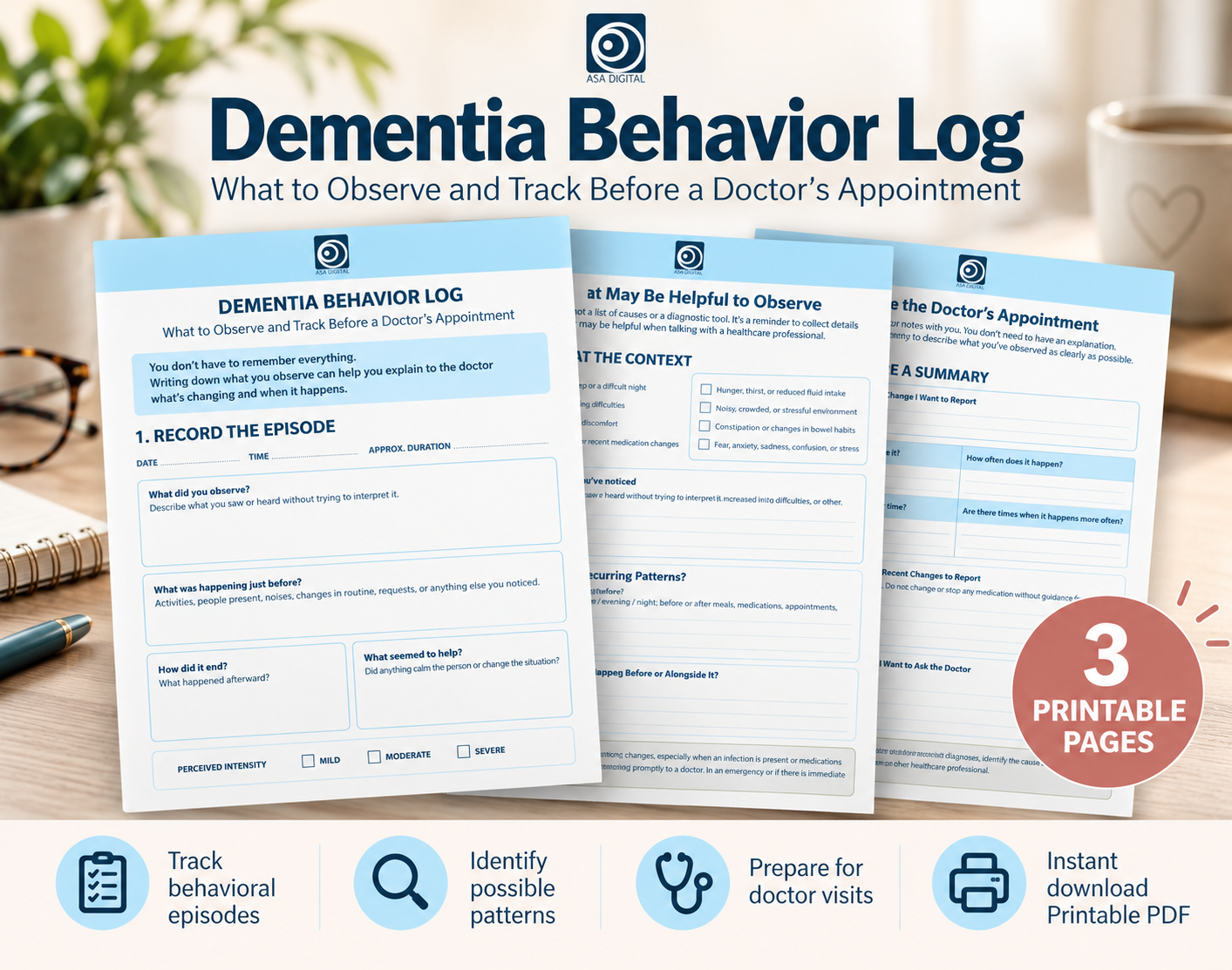
That's why we created the Dementia Behavior Log: What to Track Before a Doctor Visit, a three-page printable tool for recording episodes, the context around them, and the information you want to share during the visit.
To be clear about what it is: the log is an organizing tool. It doesn't diagnose anything and it doesn't replace medical advice. It helps you walk into the appointment with specifics instead of a vague impression.
When You Need More Than One Checklist
Behavior changes are rarely the only thing a caregiver has to think about. If you'd like a broader set of practical tools, ASA Digital's Alzheimer's Bundle (€27) features printable resources for organizing daily care.

Alzheimer's Family Caregiver's Guide – ASA Digital
A digital kit designed to help caregivers of a family member with Alzheimer's organize daily activities, keep track of important information, and manage care with simple and practical tools.
The bundle includes:
- Alzheimer's Caregiver Guide: a guide dedicated to family care.
- Daily Checklists: tools for organizing daily activities and routines.
- Weekly planners for medications and activities: to keep track of commitments, activities and medication management.
- Caregiver diary and blood pressure diary: to record daily observations and blood pressure values.
- Simple activity and drawing notebook: materials to be used together with the person being cared for, to share moments of activity.
The kit brings together organizational tools and printable materials in a single solution, designed to make the daily work of the caregiver easier.
Price: €27
You don't have to remember everything by heart
You're already carrying a lot on your shoulders: you don't have to remember every detail. Writing down what you observe, one episode at a time, can help you prepare for a clearer conversation with your doctor. And if something suddenly changes, call your doctor first and write it down later.
Sources and further information
- National Institute on Aging (NIA)
Managing Personality and Behavior Changes in Alzheimer's
https://www.nia.nih.gov/health/managing-personality-and-behavior-changes-alzheimers - Alzheimer's Association
Working With the Doctor
https://www.alz.org/help-support/caregiving/daily-care/working-with-the-doctor