

During the day, your mom is relatively calm. She has breakfast, looks out the window, maybe helps you fold a towel. Then, late in the afternoon, something shifts. She starts pacing, looks for you even though you’re in the next room, says she needs to go home. Sometimes she looks around her own kitchen as if she doesn’t recognize it.
Evening agitation in Alzheimer’s is a situation many family caregivers know well, and it’s especially exhausting because it arrives when everyone’s energy is already at its lowest.
What is sundowning?
The Sundowning, also called «sunset syndrome», refers to increased confusion, anxiety, restlessness, and disorientation that begins or gets worse in the late afternoon and evening, and that can continue into the night.
Two clarifications matter here. Sundowning doesn’t affect everyone with dementia; some people never experience it. And it isn’t a diagnosis on its own. It describes how symptoms can show up at certain times of day. That’s why sundowning is discussed in dementia more broadly, not only in Alzheimer’s.
Why Does It Happen?
The exact causes aren’t known. Major health organizations point to several factors that may contribute, though none of them explains every case.
The sleep-wake cycle. The brain changes that come with Alzheimer’s can disrupt the body’s internal clock, making sleep and wake cycles more confused. That’s why evening agitation in dementia is often linked to disturbed nights as well.
Accumulated fatigue. A whole day spent trying to make sense of a world that feels unfamiliar is exhausting. By evening, reserves run low, and tolerance for frustration may drop.
Light and shadows. When the light dims, shadows increase and can be misinterpreted. A coat on a chair can look like a person, a mirror can be disorienting.
Too much stimulation, or stimulation that keeps changing. A TV on, several people in the house, dinner noises, an unexpected visit, a change in routine: for some people, these raise tension. The way a caregiver communicates and reacts can also influence the atmosphere.
Unexpressed needs. Hunger, thirst, the need to go to the bathroom, pain, or physical discomfort can turn into agitation when the person cannot explain them.
None of these should be treated as a certain or universal cause. They’re things to observe, not faults to look for.
What Family Caregivers Can Do in the Evening Hours
There's no formula that always works. However, health organizations' recommendations suggest some prudent measures, to be tried one at a time.
1. Learn to recognize the early warning signs. Sometimes agitation is preceded by small changes: increased restlessness, repeated requests, difficulty concentrating. Recognizing this early can give you more leeway to intervene calmly.
2. Give your day a predictable rhythm. Having fairly regular times for meals, activities, and rest can help. More demanding activities, such as visits or errands, can be scheduled in the morning, if that's the time of day when the person feels best.
3. Pay attention to lighting. Turning on lamps before it gets dark, instead of waiting for the rooms to fill with shadows, may ease some of the disorientation.
4. Watch naps, caffeine, and alcohol. A long nap in the late afternoon can interfere with nighttime sleep. Caffeine, alcohol, and nicotine can disturb sleep, too. Any changes to habits should take into account the person’s condition and their doctor’s advice.
5. Check basic needs. Has he been drinking? Has he eaten? Does he need to go to the bathroom? Does he seem to be in pain? Sometimes agitation can be linked to a very real discomfort.
6. Reduce stimulation in the environment. Less noise, fewer people, a calm voice. If the person is agitated, try listening to their worries without constantly contradicting them. If she asks for “home” or for her mother, acknowledging the emotion behind it can be more helpful than insisting on logical explanations.
You also reach the evening with very little energy left. If possible, taking turns with another family member, or carving out a few moments of rest for yourself, can make these hours less heavy.
One practical tool: I also put together a free checklist, “What to Check at Home When Agitation Starts,” to help you spot a few things in the home environment that may be adding to disorientation.
What to Write Down Before Talking With the Doctor
When you tell the doctor, “The evenings are rough,” that’s true, but it’s also vague. A few notes collected over time can make it far more useful.
All you need to jot down:
- The episode time: when it started.
- The observed behavior: he walks, calls, gets angry, doesn't recognize the environment.
- The duration: how long it went on.
- The previous circumstances: what had happened in the hours before, such as meals, visitors, naps, or noises.
- Possible environmental factors: light, television, people present.
- What seems to have helped: even if only in part.
These notes can help the doctor spot recurring patterns and decide whether there’s something worth looking into behind the agitation, such as pain, sleep problems, or other health issues.
Also, during an appointment, it can be hard to remember every episode accurately. A note written in the moment lets you report more precise information.
When it is important to ask for help
It is essential to distinguish two situations.
Recurring evening agitation. If it recurs in the evening, talk to your doctor, especially if it interferes with sleep, causes significant discomfort, or puts the person's safety at risk.
A sudden change. Confusion that appears within hours or days, a sharp worsening of symptoms, significantly different behavior than usual, or unusual drowsiness should not be automatically attributed to dementia.
Sudden confusion can have various causes and requires prompt medical evaluation. If it appears suddenly, seek immediate medical attention; if severe symptoms or immediate danger are present, call 911.
It's not up to the caregiver to determine what's happening on their own. It's important, however, to promptly report any changes observed.
One small thing you can do today
Until next difficult evening, don't try to understand everything.
Just write down the time the agitation started and what had happened in the previous hour.
All it takes is a line on a piece of paper. It's a simple starting point, without requiring you to add any other complicated tasks to your day.
In conclusion
There's no single explanation or one-size-fits-all solution for evening agitation. However, when episodes recur, observing the circumstances can help identify patterns.
Noticing when it happens, under what conditions, and what seems to provide relief allows you to gather concrete information to share with your doctor.
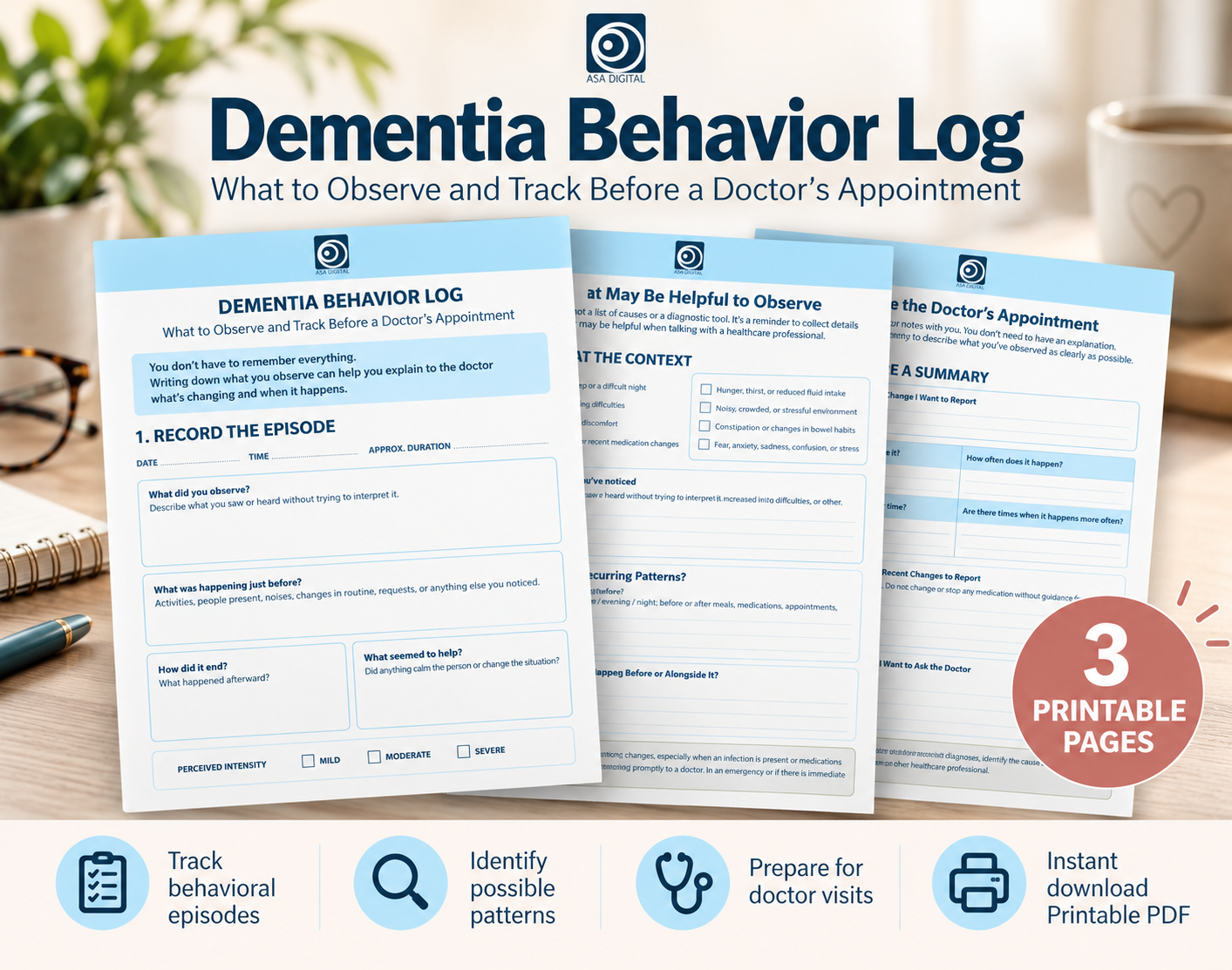
To organize these observations, I prepared the Behavior Diary in Dementia, a printable PDF designed to record useful episodes and notes during medical visits.
Warning: This article is for informational purposes only and does not replace the advice, diagnosis, or recommendations of a doctor. The information provided should not be used to make healthcare decisions without the guidance of a qualified professional. If you have any concerns or changes in your health, it is important to consult your doctor.
Sources and further information
Alzheimer's Association – Sundowning (fact sheet).
https://alz.org/getmedia/d929574d-96ab-4d27-9da9-1224cbc19233/alzheimers-dementia-sundowning-ts.pdf
National Institute on Aging (NIA/ADEAR) — Alzheimer's Caregiving Tips: Sundowning (fact sheet hosted by Boston University).
https://www.bu.edu/alzresearch/files/2010/03/alzheimers_caregiving_tips_sundowning.pdf
National Institute on Aging — 6 Tips for Managing Sleep Problems in Alzheimer's.